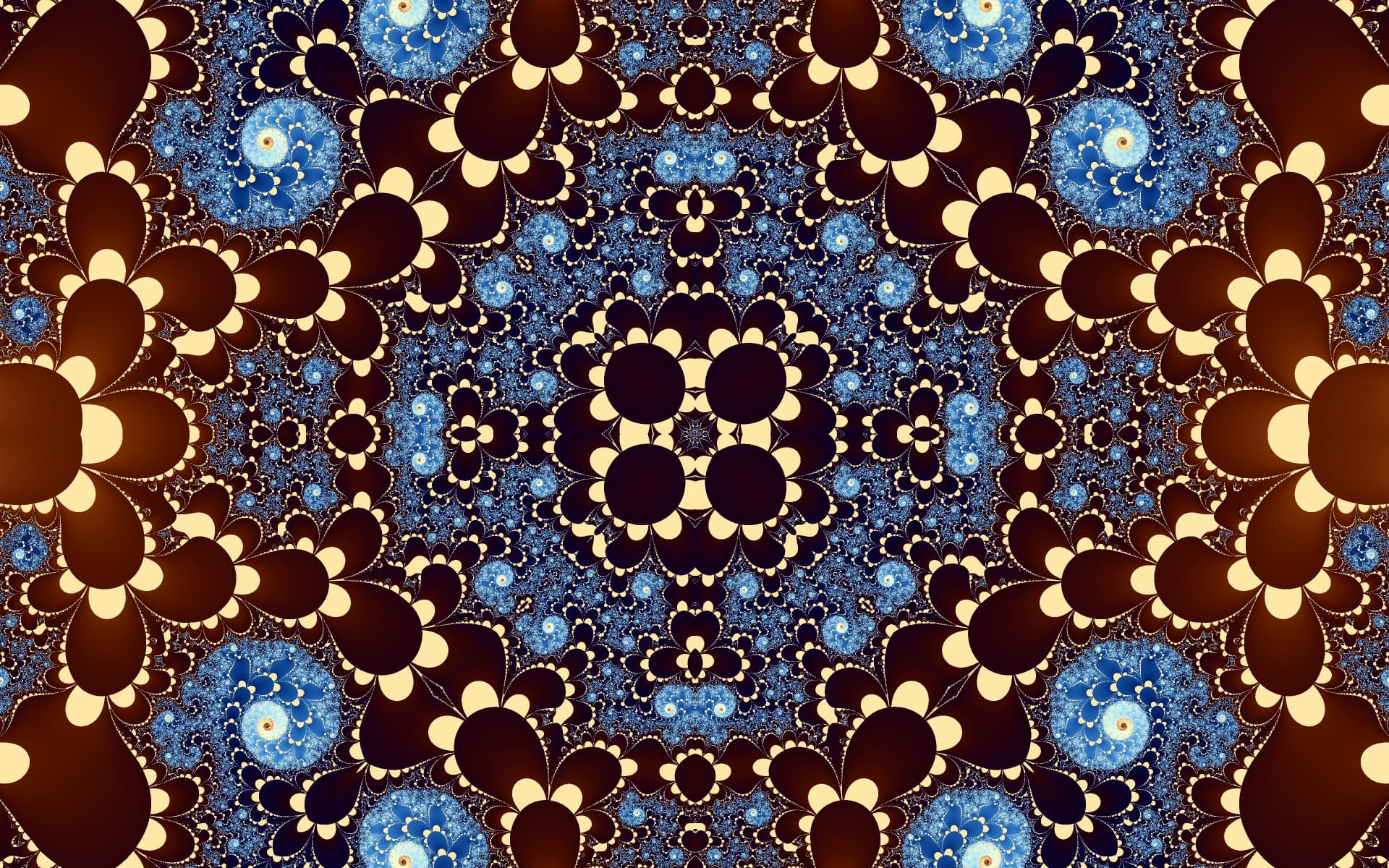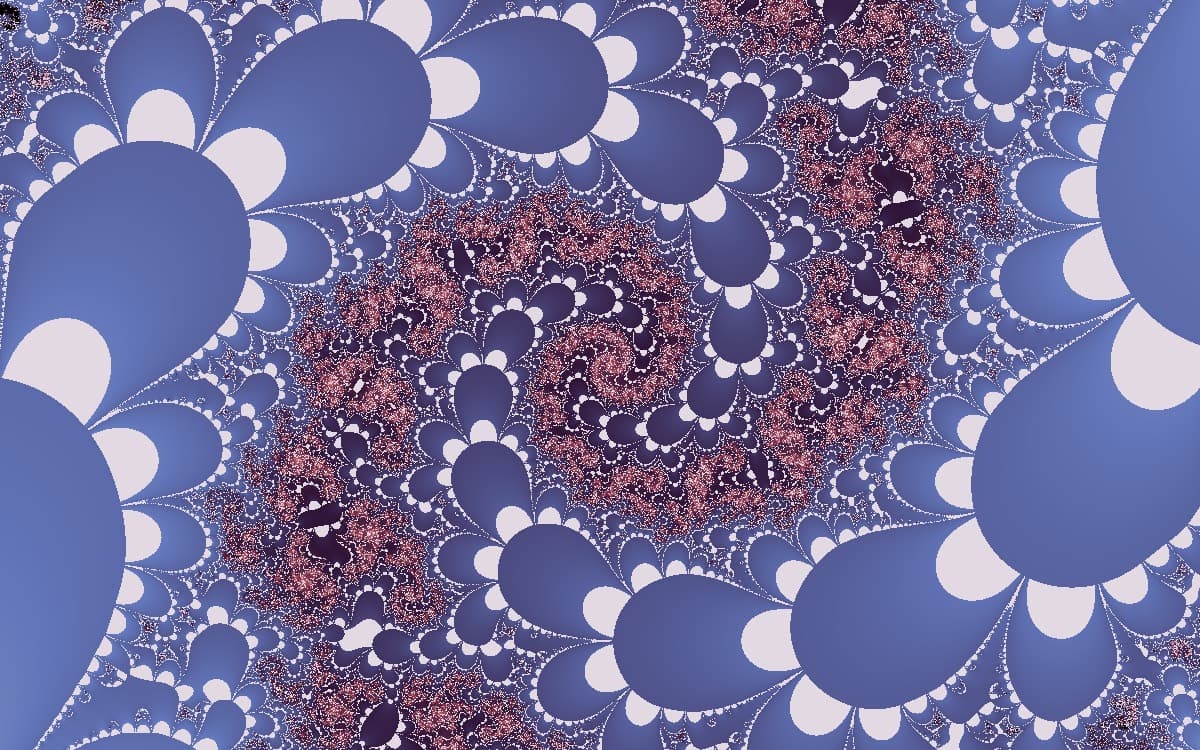
Sinusoidal rotation map
z(n+1) = exp(0.55 i) times (z(n) + 0.28 sin(z(n))) + c
Sine bends z; the fixed complex multiplier turns it; c shifts the result.
Start on the real axis. For z₀ = (0, 0), sin(0) = 0, so z₁ = e^{0.55i} × 0 + c = c. After that, complex sine can grow: the magnitude of sin(a + ib) contains terms up to cosh(b). A point with a large imaginary coordinate gets a large kick from sine, and is more likely to escape.
The 0.55-radian rotation (about 31.5°) is not a parameter; it is hard-coded in the formula. Every orbit gets the same angular twist each time. Hence the swirls.