FractalPark
ExóticaFácil

Zubieta

Um mapa quadrático que dobra as duas partes de z² + c no quadrante não negativo a cada passo, produzindo simetria de espelho dupla e formas compactas semelhantes a mandalas.

Abrir no Explorar
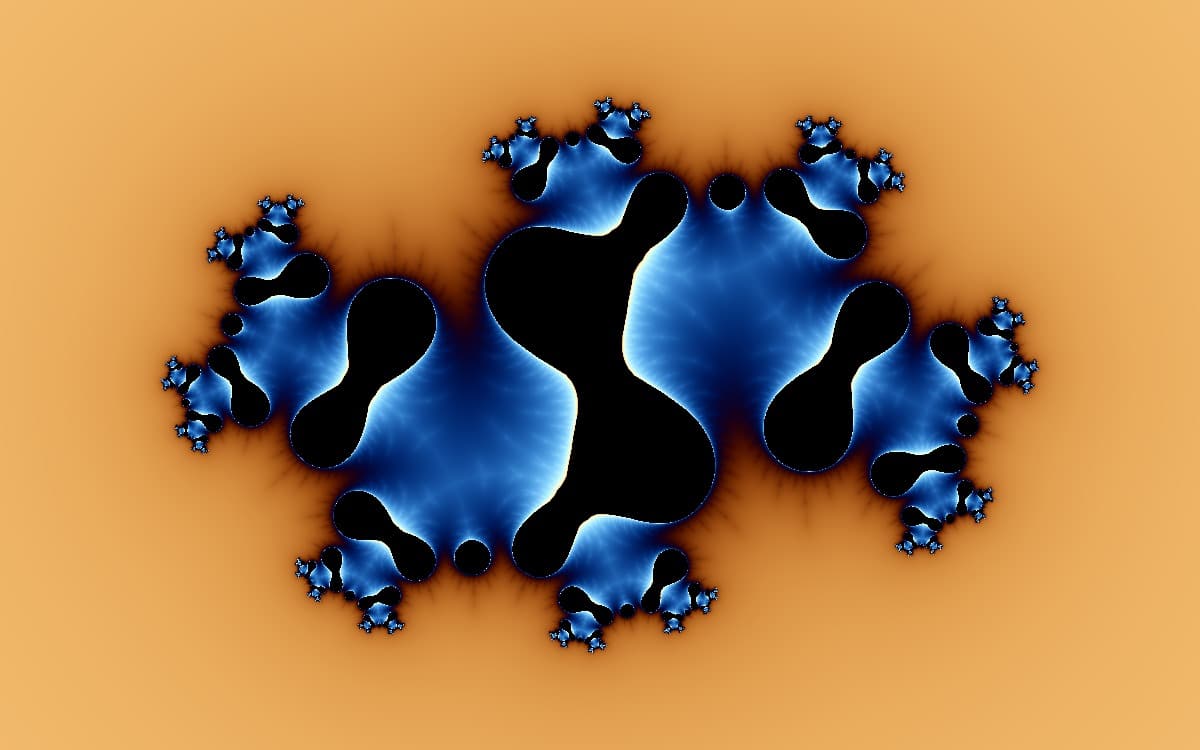
O fractal Zubieta: cunhas espelhadas e lobos semelhantes a mandalas em âmbar quente ("Kaleido Amber Mandala")
O fractal Zubieta renderizado pelo FractalPark ("Kaleido Amber Mandala"): a simetria de espelho dupla organiza lobos compactos e filamentos ladrilhados em uma mandala caleidoscópica.

Visão geral

O Zubieta é um primo de "valor absoluto" da iteração clássica de Mandelbrot. Ele executa a atualização usual zₙ² + c e depois toma o valor absoluto separadamente nas partes real e imaginária. Isso não é a magnitude complexa, que esmagaria as duas partes em um único número real. Pense em dobrar uma folha ao longo dos dois eixos: a estrutura complexa permanece, mas cada coordenada retorna ao quadrante não negativo.

Repita essa dobra e uma órbita continua retornando ao, ou passando pelo, primeiro quadrante. A simetria de espelho se acumula. O conjunto de Mandelbrot padrão tem um eixo de espelho, o eixo real; o Zubieta reflete sobre os dois eixos, dispondo quatro quadrantes espelhados como um caleidoscópio.

O Burning Ship e o Buffalo usam dobras por componente semelhantes em outros momentos da iteração. O Zubieta dobra depois de elevar ao quadrado e de somar c. Esse momento dá a ele seus próprios lobos compactos, cunhas ladrilhadas e filamentos espelhados.

A Matemática

Component-folded iteration

z(n+1) is the component-wise absolute value of z(n)^2 + c

Here the bars mean component-wise absolute value, not complex magnitude. For u = x + iy, |u| means |x| + i|y|: take the absolute value of each part. Picture folding the point into the first quadrant.

Try c = −0.5 + 0i. In the standard Mandelbrot iteration, z₀ = 0 produces z₁ = −0.5, z₂ = −0.25, z₃ ≈ −0.4375, and so on, converging to a fixed point. Zubieta folds those same values: after one step, |−0.5| = 0.5, so z₁ is 0.5 rather than −0.5. One small fold redirects the orbit—and changes how c is classified.

The escape threshold comes from the quadratic Mandelbrot test: once |zₙ| exceeds 2, divergence is guaranteed. The component-wise fold can keep some orbits bounded longer than the unfolded rule would.
História

Zubieta belongs to a broader family of "abs" fractal variants — maps that apply absolute-value folds at different stages of the quadratic iteration. The best-known member of this family is the Burning Ship fractal, discovered by Michael Michelitsch and Otto E. Rössler in 1992, which folds the components before squaring. The Buffalo fractal, another relative, applies the fold after squaring but before adding c.

The Zubieta variant applies the component-wise absolute value after both squaring and the addition of c. Its precise origin is difficult to pin to a single published academic source. Variants of this kind circulated among fractal-rendering communities and software packages (Ultra Fractal, Fractint, XaoS) in the 1990s and 2000s, often named after whoever first implemented or popularized them in a given program.

FractalPark's implementation follows the standard component-wise fold and renders the parameter plane in Mandelbrot mode.

Características Visuais

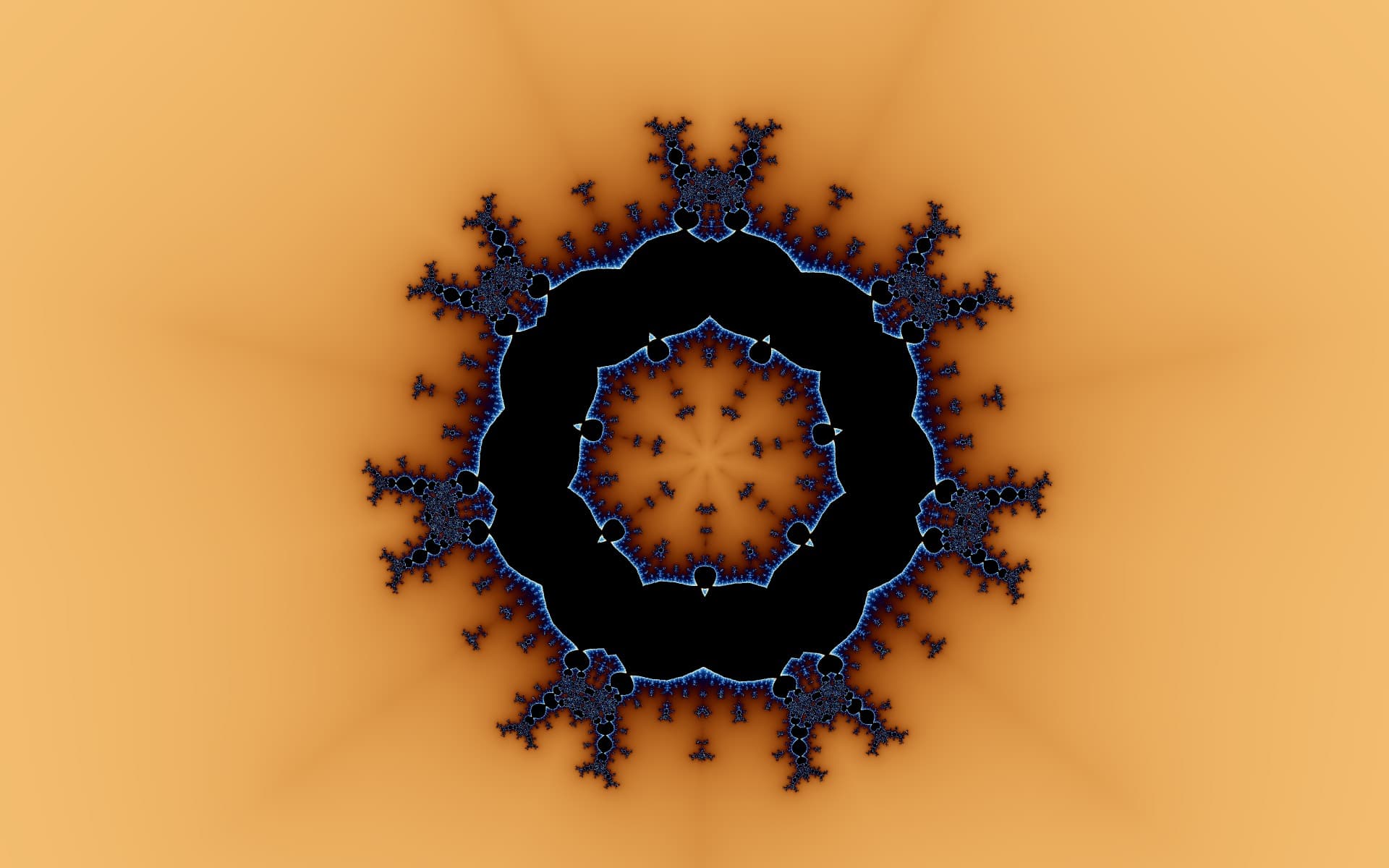
Repeated component-wise folding imposes double-mirror symmetry. The image reflects across both real and imaginary axes, making mirrored wedges, compact mandala-like lobes, and tiled filaments.

Compared with Buffalo, which folds before squaring, Zubieta's post-update fold packs its lobes more tightly. In FractalPark's canonical rendering ("Kaleido Amber Mandala"), amber colour fills boundaries patterned with repeated angular motifs.

Remix e Exemplos

Comece pelo Documento canônico

Abra o mesmo estado de fórmula aprovado usado por este guia e depois altere a visualização, a coloração, as transformações ou a animação no Explorar interativo.

Perguntas Frequentes

Is the absolute value a complex magnitude?

No. FractalPark takes absolute value separately on the real and imaginary parts. It takes |x| and |y| independently, reflecting each coordinate into the nonnegative range without collapsing the complex number to one real value.

Why is the image strongly mirrored?

Folding both output components into the first quadrant on every iteration imposes double reflection symmetry. The orbit is repeatedly sent back toward the nonnegative region, and the parameter map mirrors across both axes. Burning Ship gains its flame-like symmetry by a related fold, though Zubieta packs the result into tighter mandala-like patterns.

Referências