FractalPark
ЭкзотическиеСложно

Zaslavsky Map

Комплексное синусное отображение: синус изгибает орбиту, фиксированный поворот на 0,55 радиана вращает её, а c сдвигает её — адаптация, вдохновлённая диссипативным отображением ударного ротора Джорджа Заславского 1978 года.

Открыть в Обзоре
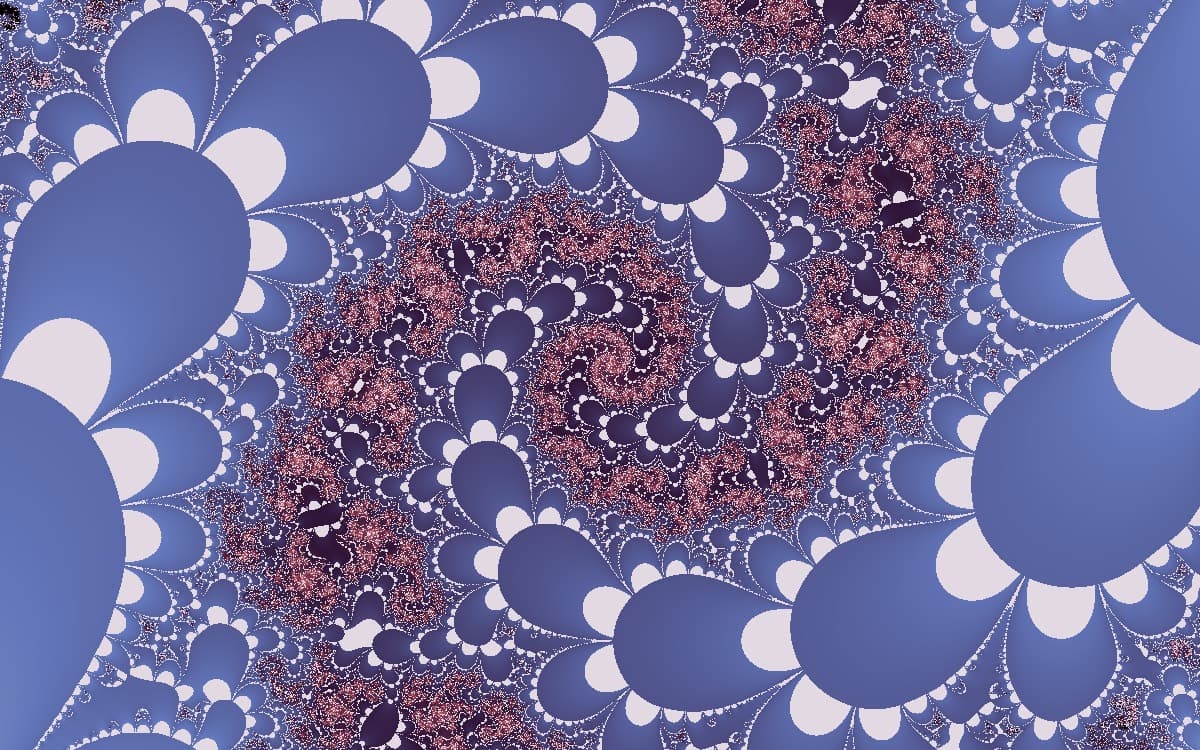
Отображение Заславского: кружащиеся рукава и мандалоподобные кольца в тёплых оранжевых и золотых тонах
Отображение Заславского в рендеринге FractalPark: концентрические дуги и расходящиеся спицы образуют светящуюся мандалу в тёплых оранжевых и золотых тонах.

Обзор

Отображение Заславского изгибает орбиту синусом, поворачивает результат на фиксированную комплексную фазу (e^{0.55i}), затем прибавляет c. Полиномиальное отображение ухода получает свой характер от степеней z, растущих всё больше и больше. Здесь сюжет строится из периодических изгибов, встречающих устойчивый поворот.

В 1978 году Джордж М. Заславский ввёл исходное отображение для моделирования диссипативного ударного ротора: вращающееся тело, по которому многократно ударяют, пока трение истощает энергию. То классическое отображение двумерно и использует вещественные переменные «действие — угол». FractalPark переосмысляет идею в одной комплексной переменной: синус поставляет нелинейный удар, фиксированный комплексный множитель — поворот, а c делает возможными изображения времени ухода при сканировании параметра.

Комплексный синус может неограниченно расти вдоль мнимой оси, так что это не просто полиномиальный уход. Орбита может некоторое время кружить, а затем разлететься. Эта заминка оставляет кружащиеся рукава и концентрические кольца, особенно после калейдоскопического пространственного преобразования.

Математика

Sinusoidal rotation map

z(n+1) = exp(0.55 i) times (z(n) + 0.28 sin(z(n))) + c

Sine bends z; the fixed complex multiplier turns it; c shifts the result.

Start on the real axis. For z₀ = (0, 0), sin(0) = 0, so z₁ = e^{0.55i} × 0 + c = c. After that, complex sine can grow: the magnitude of sin(a + ib) contains terms up to cosh(b). A point with a large imaginary coordinate gets a large kick from sine, and is more likely to escape.

The 0.55-radian rotation (about 31.5°) is not a parameter; it is hard-coded in the formula. Every orbit gets the same angular twist each time. Hence the swirls.
История

George M. Zaslavsky (1929–2008) was a Soviet‑born mathematical physicist who made foundational contributions to the theory of dynamical chaos. He introduced the map that now bears his name in a 1978 paper titled "The Simplest Case of a Strange Attractor," published in Physics Letters A. The map was derived as a stroboscopic description of a dissipative kicked rotor — a rotating system that receives periodic impulses and loses energy through friction.

Zaslavsky later moved to the United States, joining New York University's physics department and the Courant Institute of Mathematical Sciences. He authored several books on Hamiltonian chaos and fractional dynamics. The Scholarpedia article on the Zaslavsky map, written by Zaslavsky himself in 2007, provides an authoritative technical reference.

Classical Zaslavsky maps operate on two real variables (action and angle). The complex variant used by FractalPark, with its sine perturbation and fixed complex multiplier, is a creative adaptation suitable for escape‑time rendering rather than a direct transcription of the original dissipative system.

Визуальные особенности

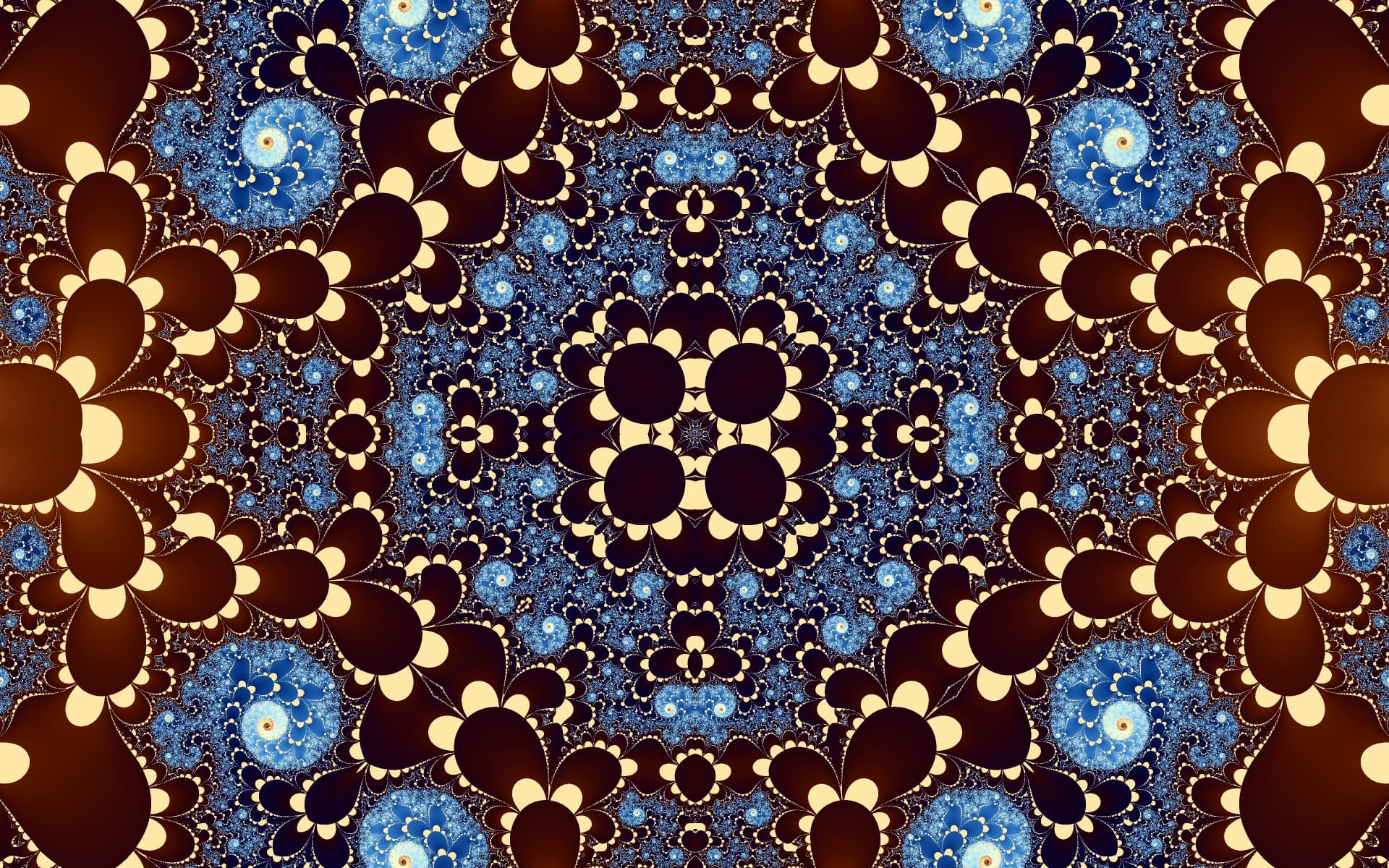
Kaleidoscopic transforms make the swirling arms and mandala-like rings especially clear. The canonical image sets concentric arcs and radiating spokes around a central region where the sine perturbation keeps orbits bounded.

Warm oranges and golds sit against deep black in the canonical rendering. Constant rotation curves the arms; sine puts fine ripples along the ring edges.

Ремиксы и примеры

Начните с канонического документа

Откройте то же утверждённое состояние формулы, которое используется в этом руководстве, а затем измените вид, раскраску, трансформации или анимацию в интерактивном Обзоре.

Часто задаваемые вопросы

Where does the rotation come from?

The map multiplies the perturbed orbit by e^{0.55i}, the unit complex number that turns the plane about 31.5° counter-clockwise. It happens on every iteration and is fixed in the formula, not adjustable by the user. The 0.55-radian value was chosen empirically for balanced swirls.

Is kaleidoscope part of the formula?

No. Kaleidoscope is an optional spatial transform outside the iteration. It reflects or copies sectors of the parameter plane. The Zaslavsky Map has no built-in reflection symmetry; the kaleidoscope is a separate rendering step that can be switched independently.

Ссылки